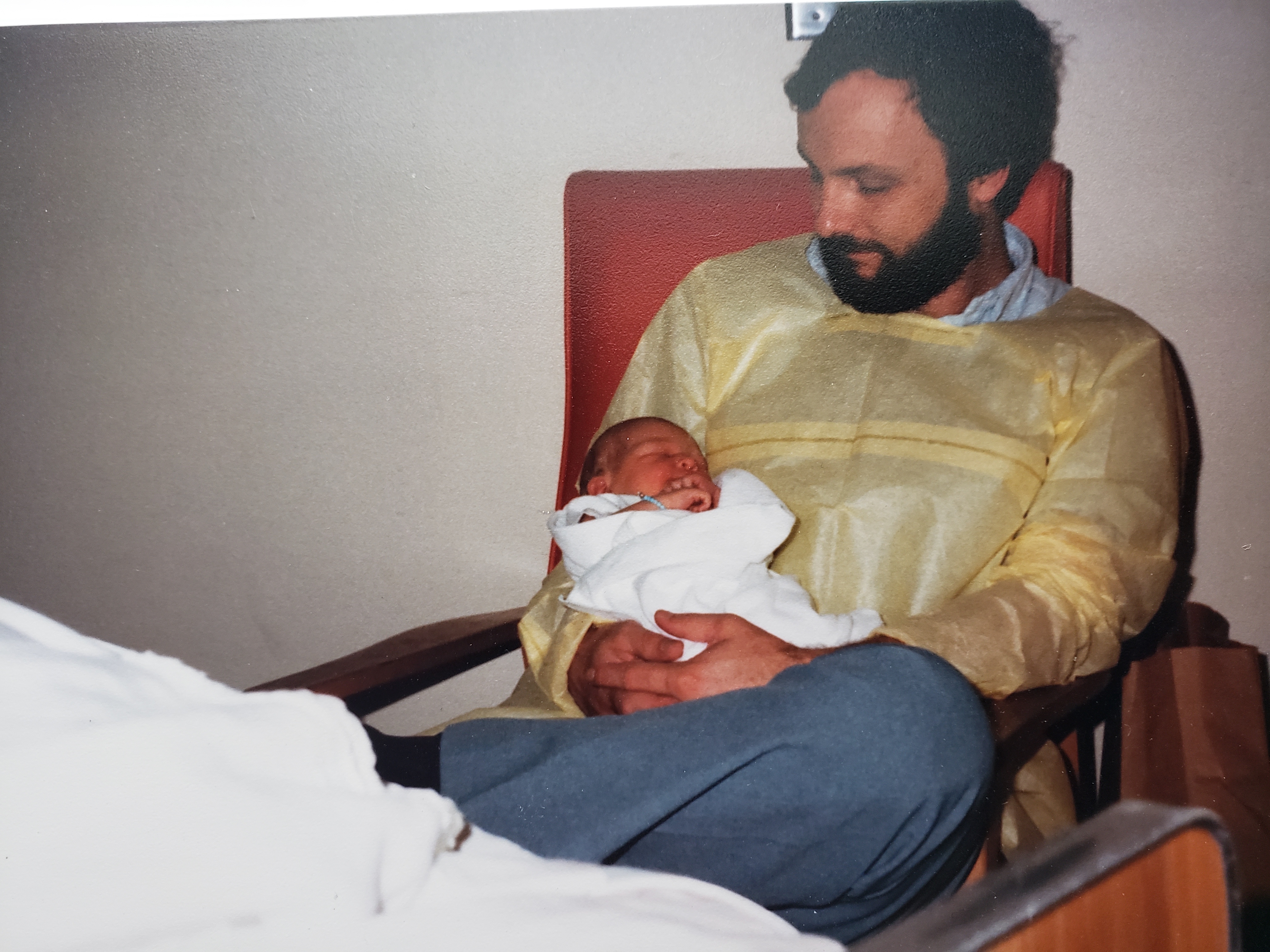
When choosing the name of my blog, I could really only think of a few things. I have done 2 “really big” things in my life- my son and my career. I love both. Not equally, my son will always have a bigger piece of my heart and soul. Genetics, however, has intrigued me since I was 12 years old. The more you learn about genetics, the more you know you don’t know. There is a nuance to every nuance and then the whole, “do we really know that?” aspect that allures me. Our genes are the code, the instruction manual and the thing that we as a society spend billions of dollars on annually to understand. Did you know that we share 50% of our genes with each of our parents (statistically speaking)? We also share a similar environment. Both impact our future.
When I was in 7th grade, my father quit drinking. My primary years had been very difficult for my family and as I was on the verge of my teen years, my father wanted to improve himself. I don’t know or perhaps I don’t recall what spurred this “phase” but for 1 year, my father quit drinking. When I came home from school, we talked about science. I taught him the 5 kingdoms and 3 types of RNA. There were only 2 of each when he was in college. My father, a college biology major himself, shared his genetics book with me. I fell in love with genetics. I wanted to know everything about DNA and what this microscopic molecule held within its hydrogen bonds (energy, duh!). I mean, really? What do these molecules tell me about myself? Was I predisposed to being a biology major because my father was? Did my shared interest in genetics mean that I shared other traits with my father? Am I destined to be an alcoholic?
When applying to school to earn my master’s in genetic counseling, a customer at my parents’ store suggested that I just “tell them about my genetic condition.” I was totally and utterly confused. I thought of genetic conditions in terms of those that are easily and concretely definable- Marfan syndrome, neurofibromatosis, achondroplasia, trisomy 21 (Down’s syndrome). But of course, everything is genetic. Things that are visible and things that are not. And environment influences how those genes are expressed. Most of our traits are multifactorial, meaning that is a combination of the genes themselves and the environment they are expressed in that determine their ultimate function. Environment includes everything from other genes and their variation, to the food we eat, the air we breathe and how often and when we exercise and sleep. And none of us are perfect. We all have flaws in our genetic code.
It is now my understanding that the “genetic condition” in my family has something to do with my father’s alcoholism. It could be influenced by shared trauma- why can’t his mother say “i love you?” Or did my father have hereditary anxiety that leads to treatment with alcohol and alcoholism was just a symptom. My father’s entire life was a struggle. It pains me to know that he couldn’t feel loved. He was a kind and loving person and extremely intelligent but every slight sent him the message that others don’t love him. Having my own family has unlocked many of those memories, thoughts and feelings. I too struggle with feeling loved. Is this it? Is this my genetic condition?
Through my multiple roles in my career in genetics, I have learned that I am a carrier for alpha-1 antitrypsin deficiency (that is a genetic condition, also known as AATD). It is also multi-factorial, meaning that carriers that don’t smoke or drink likely have minimal risks for emphysema and liver disease. My father died of small cell lung cancer. Did he have AATD? No. My mother is the one that passed this defective gene on to me. She has emphysema, but she smoked for 30+ years, as did my father. That was why he got lung cancer. Sadly, 7 years after quitting smoking. That means that cancer had been growing for 7 years. Did you know that lung cancer can take up to 10 years to identify? Since his lung cancer had already spread to his liver and he was a long time smoker, his alcoholism provided a logical explanation for the jaundice, ascites and hepatic encephalopathy. He was diagnosed 3 weeks before he died. This short period of time was hard, so hard. We had the opportunity to say goodbye but he couldn’t speak (broca or wernicke’s area were affected, its been too long since psych class to recall which). When he asked the oncologist if he could still drink, the doctor looked to me to explain to him that it was a moot point.
I wish so much that my father had the opportunities that I have had to seek professional help, to understand the complexities of what make us who we are, in our mind we create illusions that only hold us back. Genetics is just one piece to the puzzle.
I share this with you not to feel sorry for me (I’ve done enough of that for a lifetime or two). But to tell you that if you are struggling to understand why you are who you are or how to be better, genetics will not give you the whole answer (although it might be terribly fascinating and lead to an excellent career!). Our genes do not define us. They give us limits, but we decide our fate. Take control of your life. Sometimes the illusions in our mind tell us we are irreparably damaged and that we are unworthy of another persons time or affection. That is simply not true. That is my negative cycle. I am choosing to work on it and decide what my future holds. You can do the same. It just takes acceptance that you can’t make big changes on your own. It is human to need help.
 MumGene